“Market fundamentals are better than they’ve been in 20+ years”
- Michael Franco (Vornado President)

New York City office REITs presented at the BofA Securities 2026 Global Real Estate Conference last week:
SL Green (SLG) presentation and transcript
Vornado (VNO) webcast
BXP (BXP) webcast
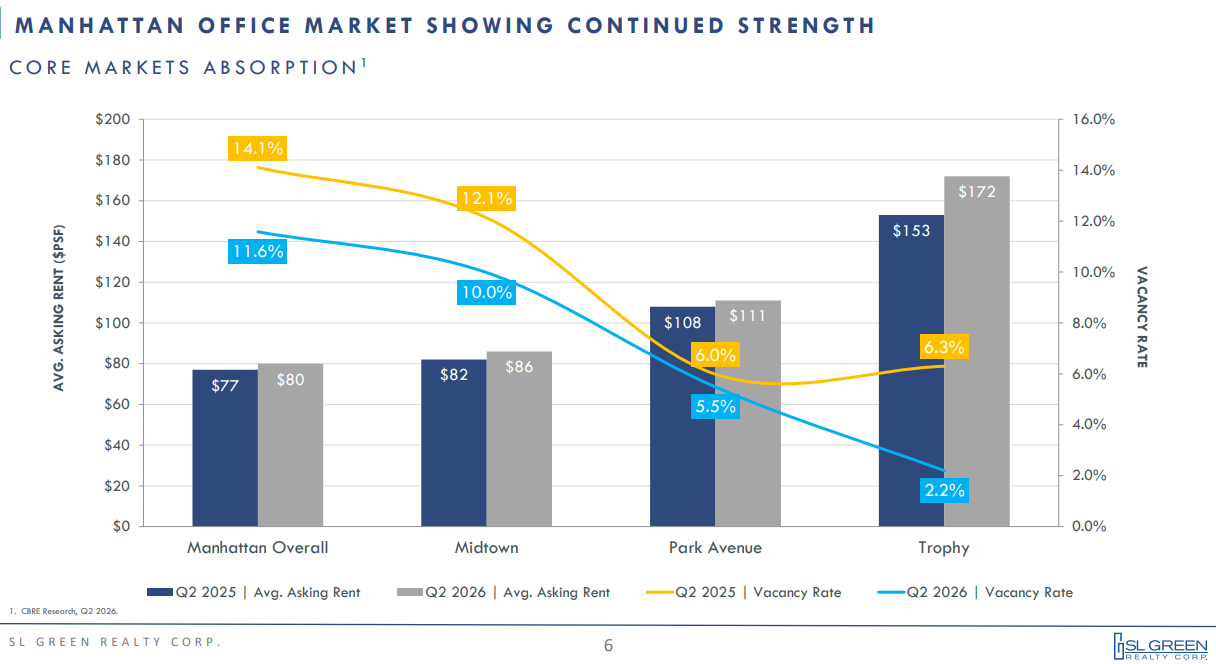
This slide nicely summarizes market conditions:
Topics:
Leasing Demand. Tenants are competing for space.
Rents and Concessions. High end +30%, mid-market +5% to 10%, and concessions declining.
Development. Tenants need more space for growth. Reception has been very favorable for trophy properties, but they take a long time and cost a lot of money so supply growth is very limited.
Politics and Mamdani. Tenants and talent have not been deterred.
Shareholder Value. Nobody cares
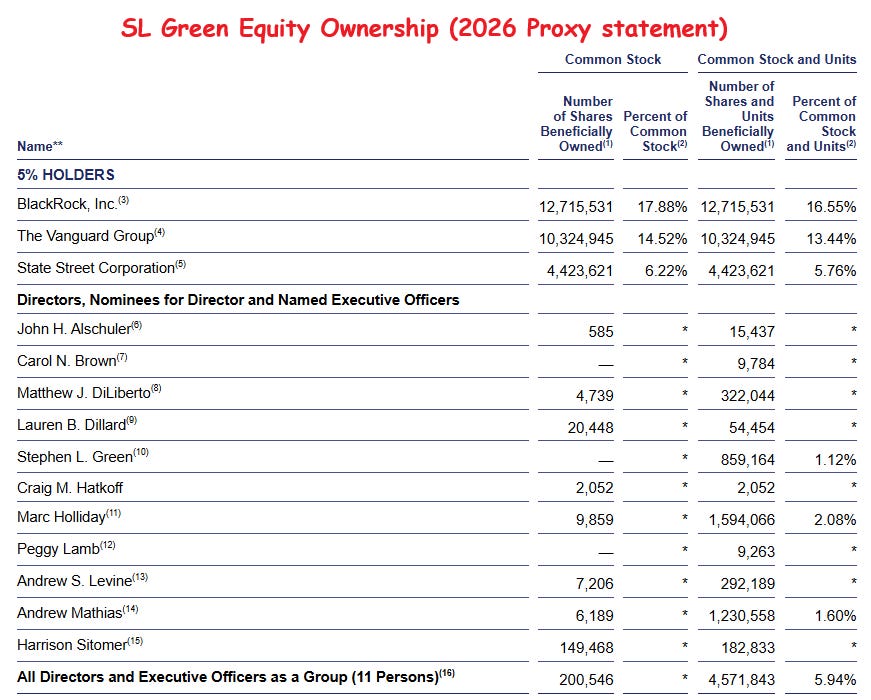
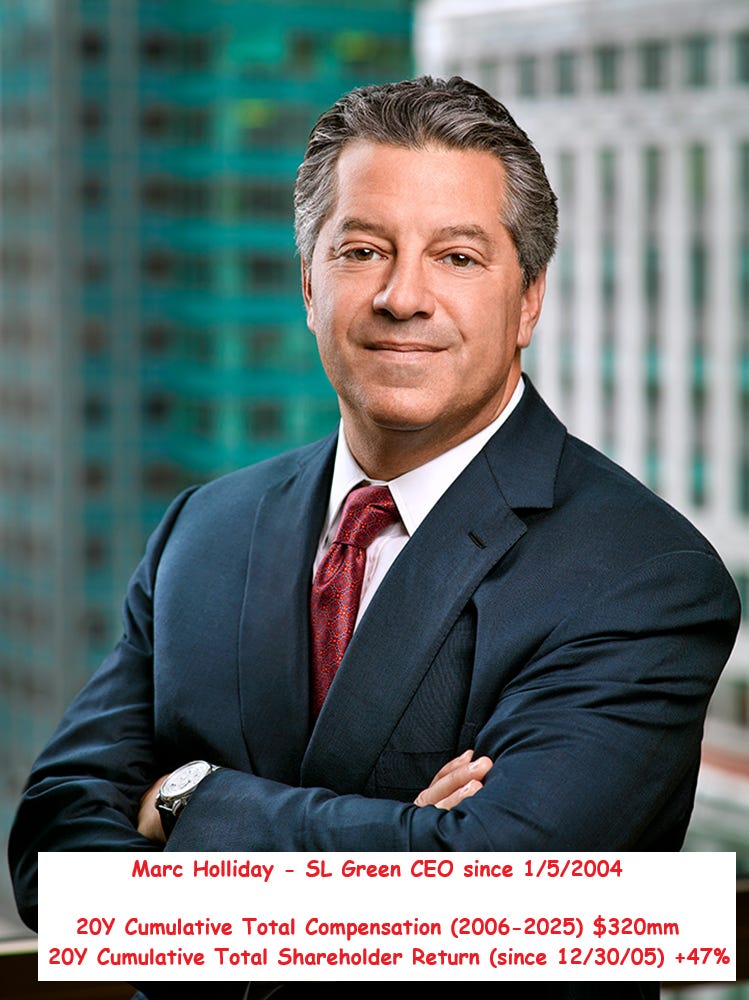
Trophy CEOs - Class C stocks. Why has Marc Holliday been paid $320mm?
Investment Perspective
This article has background information on market conditions, but does not recommend purchase of these stocks.
Leasing Demand
VNO: Young talent wants to be in New York City at a disproportionate level relative to every other city. Now that doesn’t mean they stay their entire lives, but they build their careers here and many times do stay. So driven by talent, the companies need to be here. And you’re seeing as a result of that strong broad-based demand. Financial services, legal, accounting, tech, media, every sector is active and is growing. For those companies to attract talent, they have to be in higher quality space in the right locations. That’s generally around the two main transit hubs in New York, Grand Central and Penn Station. We’re seeing tenants battling for space in all of our buildings.
BXP: Midtown is so tight for us that we have very little left to do in our existing portfolio. we have a floor at 599 Lex. We have no space at the General Motors building. We have no space at 601 Lex. We have no space at 399 Park until C. V. Starr moves out when they relocate over to 343 at the beginning of 2029.
SLG: On the leasing side, surpassing our goal for the year through less than 3 quarters of the year, with substantial amount of leasing in the pipeline.
Rents & Concessions
SLG: Rents are rising. And I think the bigger message is that rents are rising across the board. At the high-end of the market, rents are probably up 30%. At the mid-part of the market, rents are probably up 5% to 10%. I see no reason why the top end of the market, which has a 3.5% availability rate right now, won’t continue to increase by another 15% or more next year. The more affordable part of the market will be more modest. So it will be another 5% to 10%.
VNO: rents are rising everywhere, particularly for us in PENN. We used to get rents at PENN of $60, $65 a foot. We’re basically double that now. And when we first published our yields, we thought we’d get, give or take, $90 a foot. You’re seeing a combination of obviously strong market and market acceptance of the submarket and product of what we’ve done. we’ve been increasing rents over the past 3 months basically once every week or two.
BXP: Everyone talks about the frothiness of the Park Avenue submarket, where rents are increasing at significant rates. As an example, we were leasing space at 510 Madison at the top of the building at $125 a square foot a year ago. now we’re asking $175 to $200 a square foot.
SLG: you’re going to start to see compression on the concessions. As tenants end up doing more renewals or there’s spillover from the high end of the market over to maybe the next tier down of buildings, because that’s where tenants can find space, you’ll start to see some increased velocity and some improved net effectives in those type of buildings.
VNO: Rents are rising, free rents coming down and even TIs are starting to tighten. So it’s certainly a landlord’s market period. Term is no issue. We’re still in the 10- to 15-year range, no change at all on that. If anything, people want flexibility for expansion, more than I’ve ever seen because people are growing a lot. Net effective rents are up certainly in the high single digits, if not at 10% at this point.
VNO: The new supply needs rents of, call it, $250 a foot or more, all of it, whether it’s 625 Madison, 343 Madison, 275 Park, whatever it is. That’s great for us on the renewal theme because our rents aren’t $250 a foot. You have tenants who are in a tweener situation where their leases are coming up 3, 4, 5, 6 years from now. They don’t want to move to new supply because it’s too expensive.
SLG: Rents for big corporations in New York used to be something around 4% to 5% of their overall revenues. Today that’s sitting between 1% to 2%. The denominator effect is playing right to our business model.
Development
SLG: [346 Madison] The feedback has been great. People love the location. It’s a block away from Grand Central. It’s across from BXP’s new development at 343 Madison. And it will be a highly amenitized building. It will be a very notable architecture that will stand proudly on the skyline with a very unique profile. We’ve rolled out rents to tenants, and with the most recent leasing success on high-end buildings in Midtown, tenants aren’t shocked. It’s a building that will trade in the $230 at the bottom of the building and into the 3s at the top. That’s what tenants are expecting for that kind of high-quality product.
VNO: [350 Park] The response has been 5-star unbelievable response to what we’re doing. And tenants are looking that far out already because they’re out of space. $350 at 350 - That’s our marketing slogan.
BXP: [343 Madison] We’re now 56% leased. We launched this spec 13 months ago, and we have a letter of intent with another firm to take the bottom 5 floors. And if we get that done, we’ll be at 70% pre-leased after only 13 or 14 months.
VNO: There’s limited new supply, and it’s extremely hard to build in this city, both from a cost standpoint, from a time standpoint. This is not Atlanta. This is not Charlotte where you can slab up a building in 2 years, right? If you look at the supply there’s maybe 5 buildings that are started or about to start. You’ll probably have one of those deliver a year starting in ‘29. That’s not a lot of supply. And every one of those buildings is at least 50% pre-leased. And most of that constitutes expansion space for those tenants that are pre-leasing that. So that’s not much supply to add over the next 7 years. I think we’ve gotten to the point now as good as all this is, for New York to be successful, we have to have some new supply. We don’t want a massive bulge, and you’re not going to see that.
SLG: The office to resi conversion phenomenon is something that has had a meaningful positive impact on the leasing environment, particularly for the more mid-priced point buildings. The biggest tailwind we have right now in our sector, especially New York, is it takes 6 to 7 to 8 years to plan and develop projects. We’ve scoped out what can be delivered through 2032 in the most optimistic scenario and the inventory netting against office to resi conversion is actually negative. And as interest rates go higher, projects that are not of the highest caliber developer become harder to develop, supply will dwindle down, and the rental appreciation that we’re talking about is going to be significant.
Politics & Mamdani
SLG: Leasing is the biggest indicator. We just look to what are the big tenants doing in this market and what type of commitments are they making. New York City is on track this year for its biggest office leasing year since 2019, and that’s a great indicator for us as the type of businesses that want to be here and their employees that want to be here.
SLG: We’ve been working actively with the city and the city administration over the past year, whether that be at the mayoral level, whether that be at a deputy mayoral level, or with the City Council and the newly elected City Council Speaker. We’ve been very pleased with the responsiveness and feedback that we’ve gotten from the city on initiatives that we brought to them. And it’s been very positive signals from the mayoral administration in some of the recent hires including Anthony Shorris, from McKinsey, who came over to lead EDC.
VNO: I love Ken Griffin’s quote that my business is going to be here a lot longer than the administration. That’s how companies think, right? They’re here long term. The talent wants to be here regardless of who the mayor is, good, bad, whatever. And so companies are growing here. Big tech is growing more here than on the West Coast. Obviously, financial services is the center of the world. Legal is the center of the world, health care. If you want the best of the best, you come in New York City. And so we’re not seeing any change in tenant behavior. If anything, we’ve seen companies growth accelerate over the last year.
Shareholder Value
VNO: We bought stock back. We’ll talk about that if you want. I think we’ve done a number of positive steps. The stock has performed a little bit, retrenched here recently. And I think that it’s sort of shocking, given the fundamental backdrop, where certainly New York City office stocks are trading.
SLG: 🦗🦗🦗
BXP: 🦗🦗🦗
Trophy CEOs - Class C Stocks
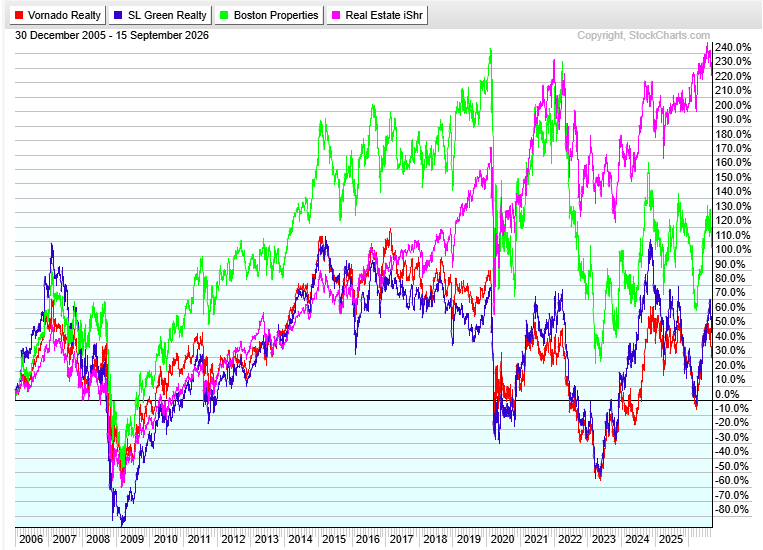
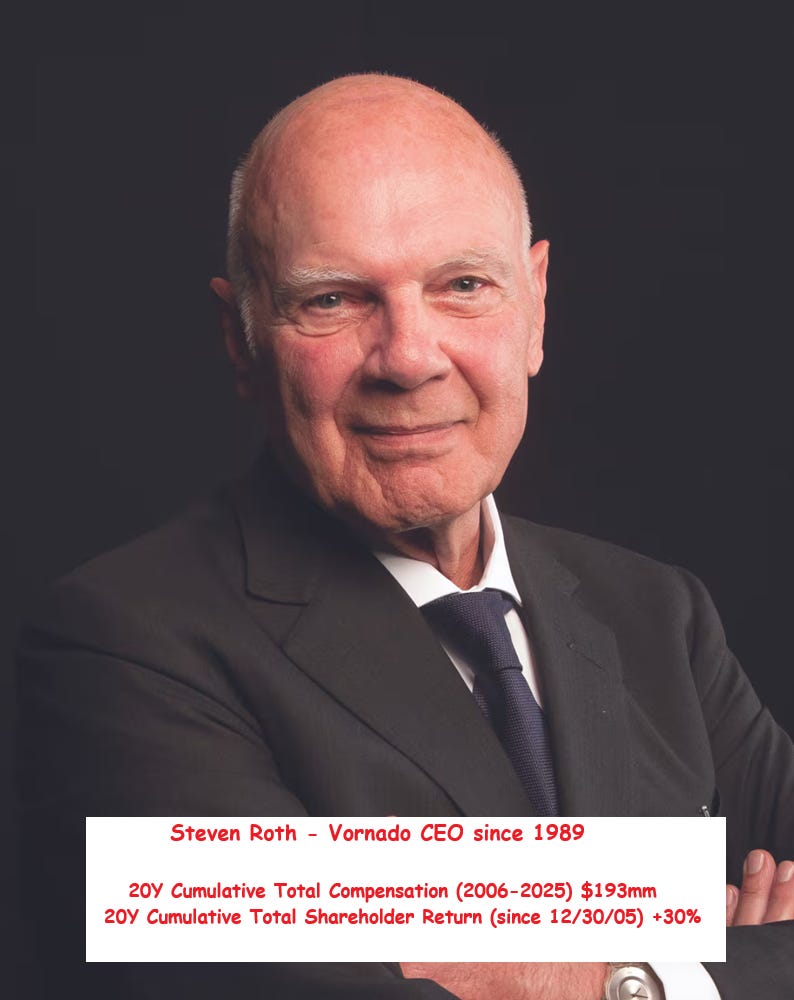
These REITs own the best properties in the world’s strongest office market. Their CEOs are highly compensated industry titans. They have generated terrible returns for public investors, especially in the past 10 years.
SL Green (SLG)
SL Green has a negative cumulative total return since 7/18/06. Insider ownership is minimal. CEO Marc Holliday has never purchased shares since becoming a reporting insider - his entire equity interest was received as compensation.
BXP (BXP)
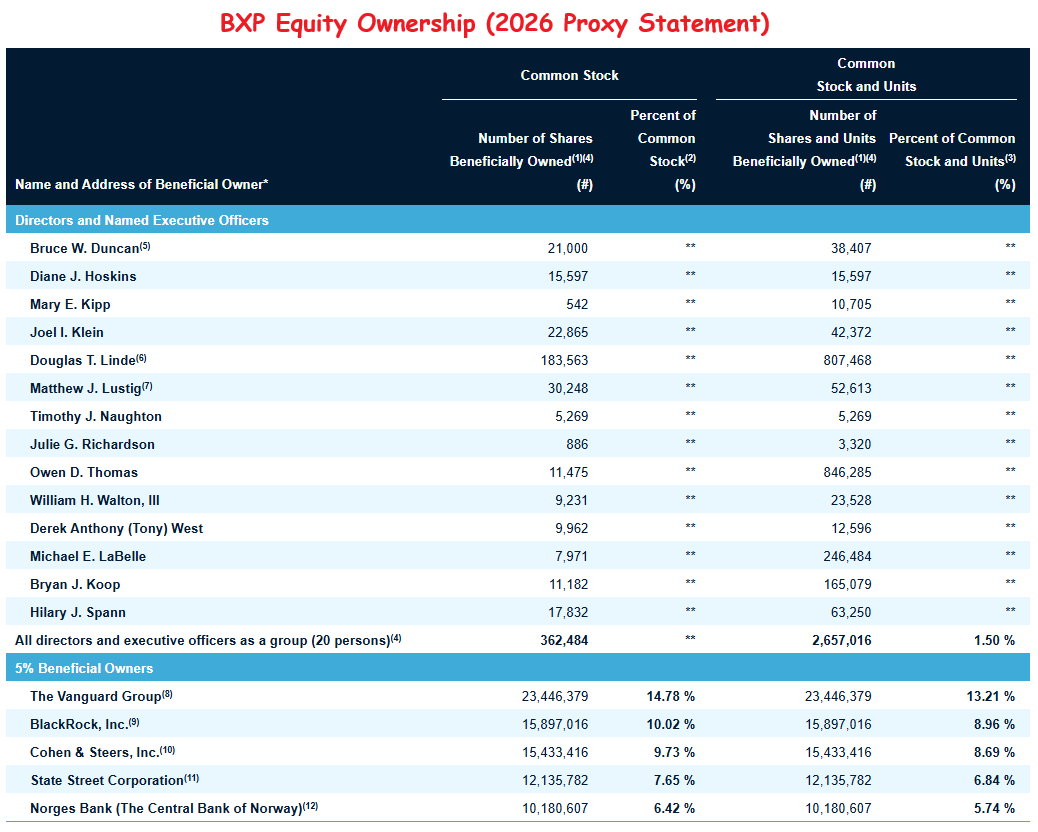
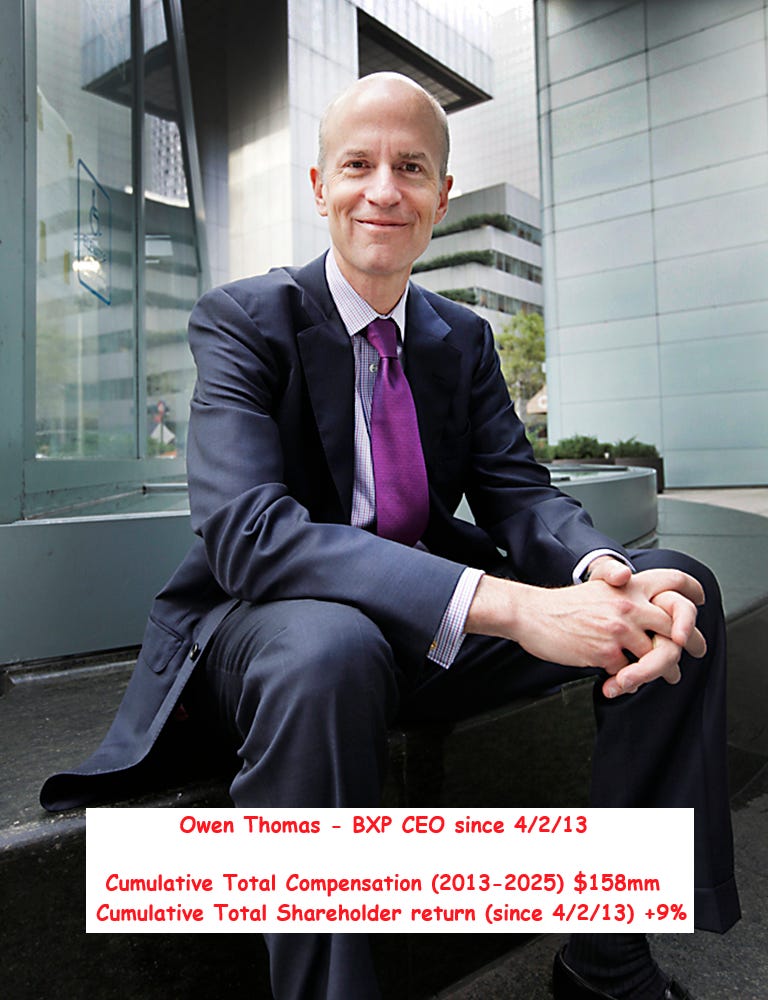
BXP has a negative cumulative total return since 7/13/13. Insider ownership is minimal. CEO Owen Thomas has not purchased shares since 2013. Nearly his entire equity interest has been received as compensation.
Vornado (VNO)
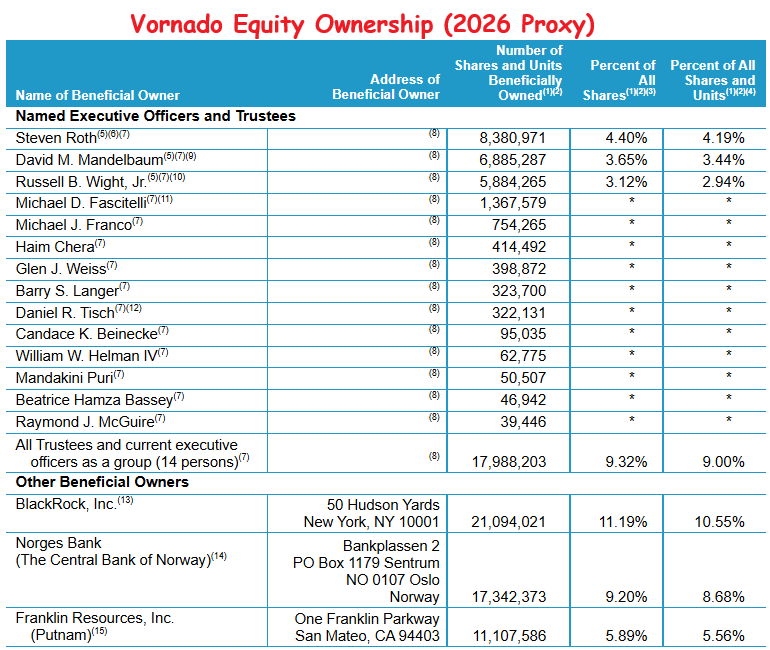
Vornado has a negative cumulative total return since 9/8/06. Insider ownership is meaningful, and primarily in the form of shares rather than units received in compensation. CEO Steven Roth has not purchased shares in over 25 years, but other insiders have occasionally bought. Roth’s equity interest (along with those of David Mandelbaum and Russell Wright) dates to their 1970s partnership (Interstate Properties) which gained control of a Vornado in 1980 when it was just a struggling discount retailer.
Investment Perspective
While the NYC REITs appear attractively valued, their longstanding failure to deliver value to public shareholders makes any investment seem naive.
Vornado is still managed by founders with significant equity. SL Green And BXP appear to have a professional management culture where the executives work for the company and each other rather than the shareholders. SLG Founder Steven Green and BXP founders Mortimer Zuckerman and Edward Linde sold most of their equity long ago.
BXP has never repurchased stock. It paid a large special dividend of $5.98/share in January 2008 using asset sales proceeds. At that time Zuckerman and Edward Linde still held about 14% of the equity.
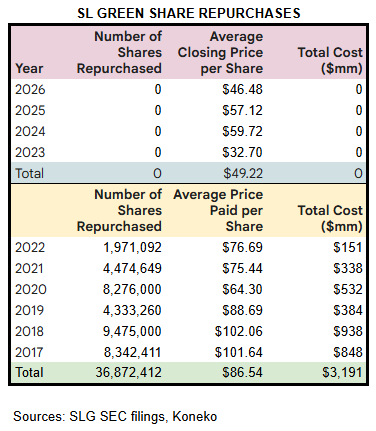
SLG repurchased $3.2Bn of stock from 2017-2022 at an average price of $86.54/share and none from 2023-2026 when the average closing price has been $49.22.
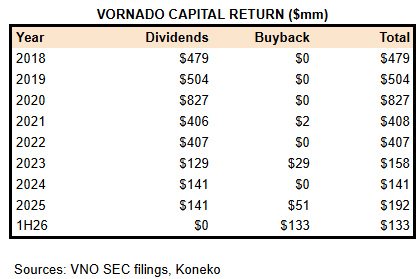
Vornado has repurchased shares in 2023-2026 using cash saved from slashing dividend payments. VNO paid a special dividend of $1.95/share in 2020 to distribute taxable income from closings of 220 CPS condo sales and contribution of retail assets to a joint venture.
The divergence between strong real estate fundamentals and lagging shares creates an opportunity for activist involvement. A 10% stake would cost $370mm (SLG), $650mm (VNO), or $1,020mm (BXP). Paramount Group (PGRE) sold for $1.6Bn last year to Rithm Capital (RITM) after PGRE had been pressured by unsolicited buyout offers and had some turmoil among its executive team. RITM CEO Mike Neirenberg explained that he was buying at a 7% cap rate, expected several years of strong NOI growth, and could exit at a 6% cap rate. Similar math could be applied to SLG VNO and BXP, but can their management teams be trusted to realize that appreciation and deliver the benefits to their investors?
Disclosures & Notes
At the time of publication the author held shares of Rithm Capital. This disclosure should not be interpreted as a recommendation to make any transaction in any security. Investors are encouraged to check all of the key facts cited here from SEC filings and other sources prior to making any investment decisions. The author believes all information in the article is accurate as of the date of publication.
This article has been published without a paywall because it does not contain an actionable idea.
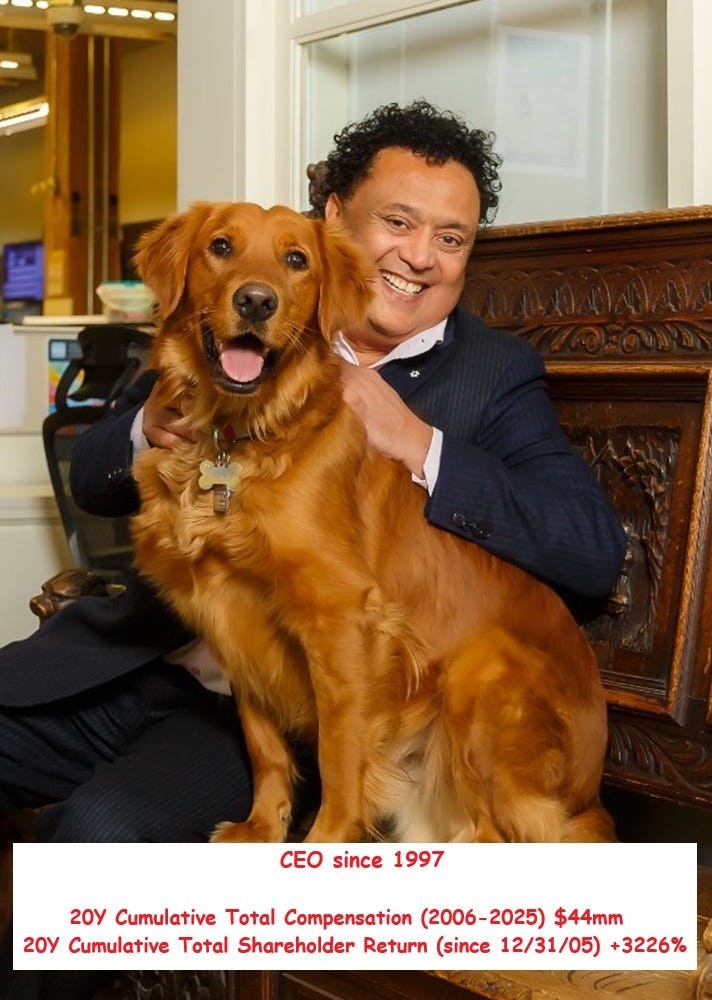
While the SLG BXP and VNO CEOs have been hugely overpaid relative to investor returns, this Canadian real estate CEO (shown below, at right) has delivered.