

Investors who purchased $104mm of Class A shares in GO Partners acquisition of 685 First Avenue now hold Go Residential REIT units worth only $39mm, a return of -62.1%. Maybe that explains Meyer Orbach’s recent interview comment: “our friends and family stopped taking our calls”.

Tom Hofstedter of H&R REIT said the GO team has “a real track record”. What is it? Maybe Josh Gotlib’s extraordinary accumulation of Housing Code violations? GO’s narrative is that rents are rising and occupancy is high. Investors are encouraged to believe that GO’s ownership of its initial five property portfolio has been highly profitable. This report tests that thesis with information from these sources:
GO Residential REIT Prospectus, especially pages F-29 to F-91 showing the pre-IPO Financial statements for GO Partners
Colliers Valuation reports for the initial GO REIT portfolio (685 First Avenue, American Copper Building, 1 Sutton Place, 2 Sutton Place, 1 East River Drive)
Contribution Agreement between GO Partners and GO Residential REIT
Exhibits filed in the Kassirer vs Gotlib and Gold Wynn vs Kassirer lawsuits.
Key findings:
GO Partners incurred substantial cash operating losses
GO Partners operated with extremely high leverage and invested close to zero in property improvements
Investors in GO Partners appear to have had their equity converted into OpCo units of GO REIT at high valuations (at least $18/unit) and now have significant losses.
685 First Avenue Ownership Structure, Fees, and Returns
The five properties in the initial GO REIT portfolio each had their own equity investors and debt financing. The offering document for 685 1ST AVE LLC (filed in the Kassirer case) shows these terms:
Expected equity $111mm. Of this $103mm was raised from investors and $8mm was equity compensation, primarily paid to GO Partners. Invested equity was only 27% of the $388mm purchase price.
Expected property debt of $291mm. Note that the actual debt incurred was much more costly - an extra $5.2mm/year of interest expense.

Expected terms from Confidential Private Placement Memorandum, actual terms from GO Partners Financial Statements notes Class A Shares were raised through the private placement
Class B Shares were incentive compensation for the manager. GO Partners would receive 20% of returns in excess of a 6% preferred return for the Class A interests.
The manager also received fees for fundraising and debt guarantees.

In the event of a Like Kind Exchange (as eventually happened with the conversion of 685 1ST AVE equity into OpCo units of GO REIT):
Manager receives a 1% fee
Class B units are converted into Class A - the manager realizes the promote, if any.
This cap table filed in the Kassirer case shows contributions from 28 investors:
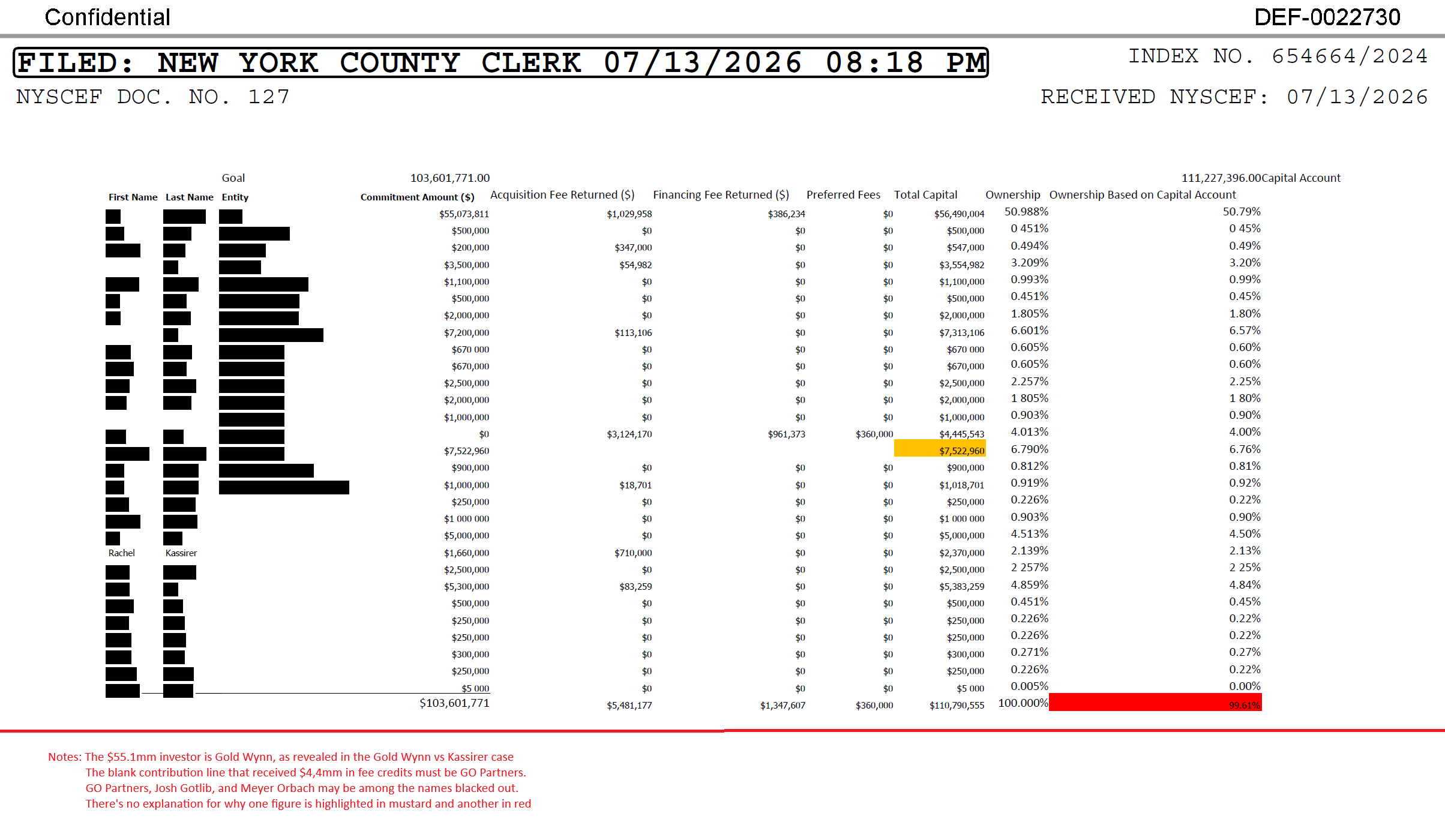
The property was acquired on 9/23/22 for $387.5mm. Colliers Valuation report notes that it was an arms-length transaction at market levels.

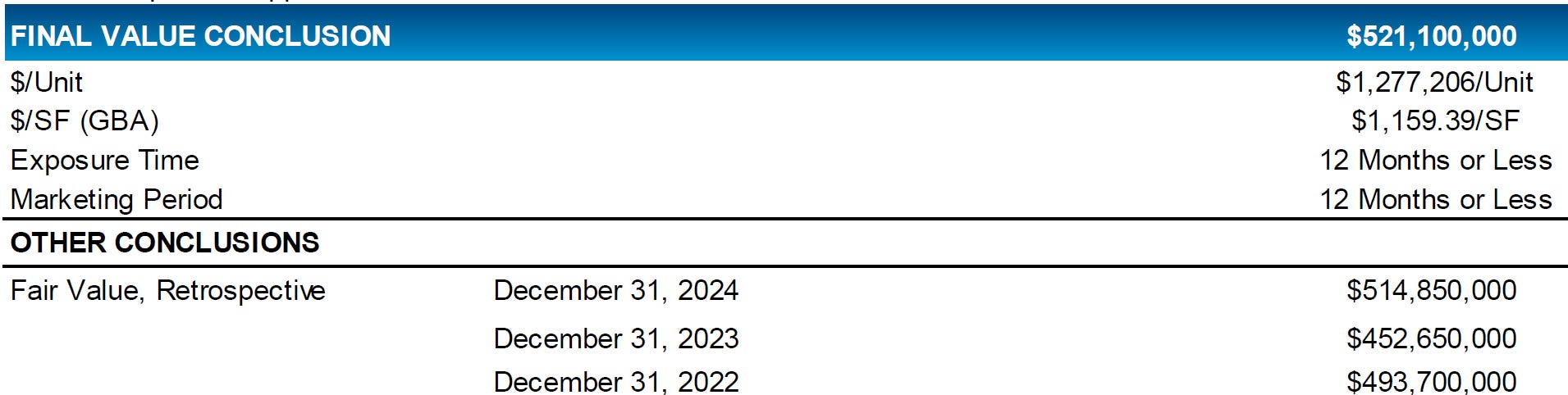
Colliers ignored this demonstration of the true market value of the property and arrived a spreadsheet valuation of $494mm (27% higher) as of 12/31/22 and a final value of $521.1mm as of 3/31/25.
The Contribution Agreement shows that existing equity holders in 685 1ST received 5,085,106.95 OpCo units when the property was acquired by GO REIT.

I don’t think the basis for calculation of the exchange ratio has been publicly disclosed, but investors have undoubtedly suffered a large loss:
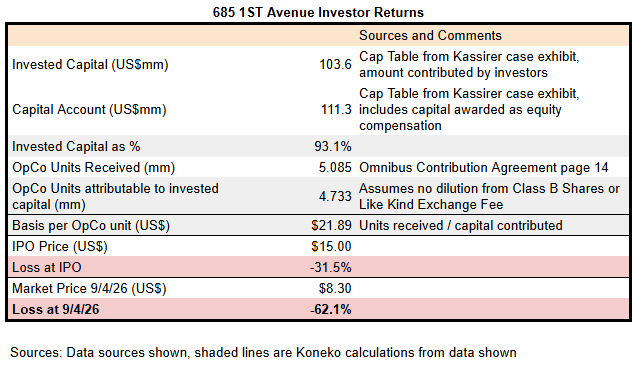
Investors did not receive any benefit from the Colliers spreadsheet appreciation. Colliers also showed an income statement for the property with cash losses of $14.6mm for 2023, 2024, and 1Q25.
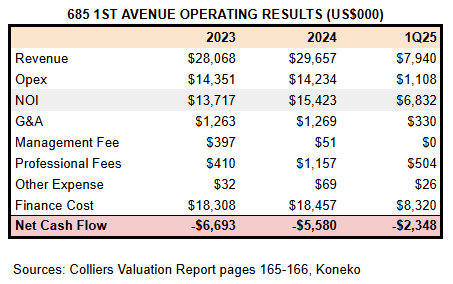
One remarkable detail in the income statement is how little GO invested in 685 following its acquisition. The GO strategy is exactly what Meyer Orbach said in his TRD interview: “it’s almost like a simple formula. Raise the rents, cut the expenses”.
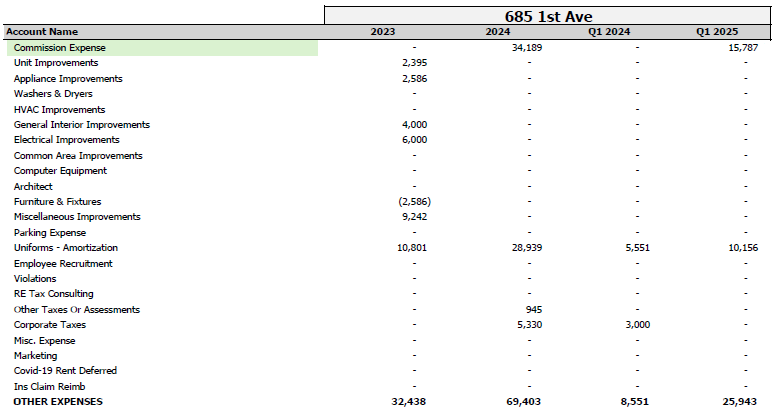
Cash losses, high fees, deferred maintenance, and negative investor returns - that’s the “real track record”.
Copper Buildings, 1&2 Sutton Place, 1 East River Drive
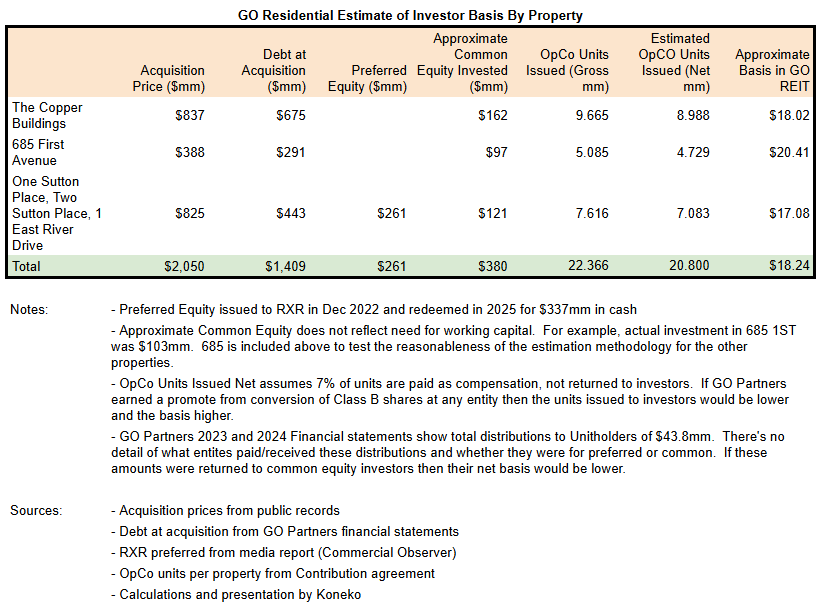
We have less visibility into investor returns at the other GO properties because they have not, at least not yet, been the subject of lawsuits. From more limited information I estimate that investors in the GO Partners portfolio entities have a basis of at least US$18/unit in GO Residential REIT, had a significant mark-to-market loss at IPO, and a much larger mark-to-market loss as of 9/4/26.
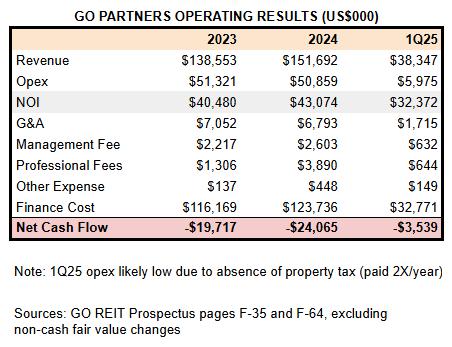
Consolidated GO Partners Operating Results showed an operating loss of $47mm for 2023, 2024, plus 1Q25.
Colliers valuation spreadsheets showed magical appreciation for every property after acquisition.

If these gains were real then management completely failed to deliver their benefits to the investors in the GO Partners LLCs. That’s the "real track record”.
GO Is Addicted To Debt
While GO Partners investors suffered dilution through the IPO pricing below their cost basis, the IPO proceeds allowed a prudent deleveraging. However, GO REIT has since purchased $652mm of additional properties while raising only $72mm in new equity.
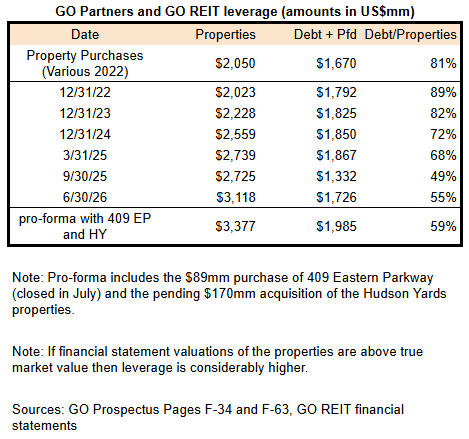
The proposed Lantower merger would be a second dilutive deleveraging, but isn’t it probable that GO will just buy more properties again? That’s the “real track record”.
Disclosures & Notes
At the time of publication the author held units of H&R REIT and no position in units of GO Residential. This disclosure should not be interpreted as a recommendation to make any transaction in any security. Investors are encouraged to check all of the key facts cited here from SEDAR filings and other sources prior to making any investment decisions. The author believes all information in the article is accurate as of the date of publication.
A copy of this article was sent to H&R REIT at the time of publication. If the company can identify any factual errors using information that was public at the time of release then corrections will be made as promptly as possible.
I believe this article serves the public interest so it has been published with no paywall. Please share with anybody who might be interested.
Calculation of the Go Partners’ investors’ basis in GO REIT used the facts and assumptions shown. If you disagree with any assumptions or have new facts that would enable an improved calculation then please share.
Excellent write up full of documented facts! These Go guys and their new partner Tom are nothing but swindlers! This proves a lot about the Go group and their business plan to reap millions in incentive bonuses and through the shareholders under the bus and have a big smile on their face like that low life CEO had on his face during that pathetic interview! He came across as a con man which he obviously is ! This is one shady transaction by HR which after research isn’t surprising! These groups are treating this manipulation like it is a private company which it isn’t! If the securities commission doesn’t torpedo this deal and levy heavy fines with suspensions and more! They might as well consider themselves irrelevant and climb back under their rock! I will be voting NO when I get a chance! Wonder how they are spending those last distributions they are not paying the shareholder? Probably some executive lunches with their buddies making their next plan!
Curious how you alude to the bankruptcy risk? It currently has investment grade rating and I get an average of somewhere in the ~$800k unit range if we look at it like that which is clearly well below half of private market Manhattan comps. I agree with you the group appears to be somewhat incompetent so they can overleverage themselves again but as of now I don't see bankruptcy risk or even close to it. Would love to see if you see something we don't see other then they are shady actors in terms of risk which could lead to bankruptcy?