

H&R REIT’s (TSX:HR.UN) strategic plan correctly recognized that the complexity of its diverse portfolio resulted in a discounted valuation. Meaningful progress has been made in the past 5 years, but the anticipated benefits have been lost to adverse market developments, a downturn in the US Sunbelt residential market, and a crash in the Toronto housing market.
The plan’s originally envisioned 5-year timeline is not a fixed deadline. HR’s strong financial condition at 6/30/26 and subsequent asset sales provide flexibility to continue repositioning over the longer period that will now be required to realize reasonable value from certain non-core assets, or sell if a fair offer is available.
Topics:
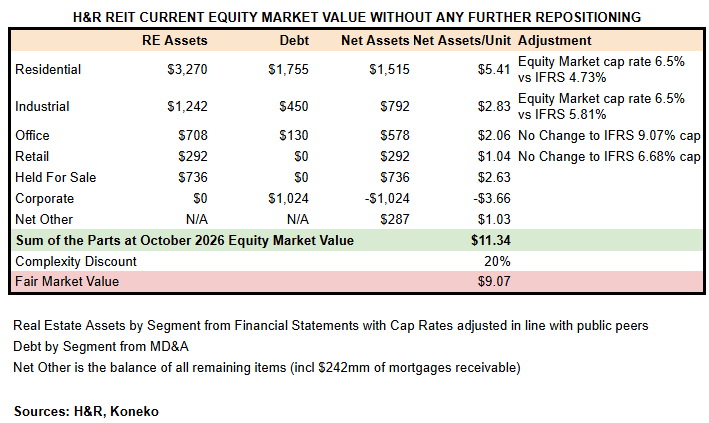
H&R at 2Q26: NAV=$16.24, Equity Market Fair Value = $9.07
Lantower REIT Potential 4Q26 Value: NAV = $15.89, Equity Market Value = $11.23
Strategic Options: Cash Sale = $11.50, Cash + Liquidation = $13.86, Wait = $15+
Non-Core Assets: Not so complicated
Deal Termination = Hofstedter Termination?!
H&R At 2Q26
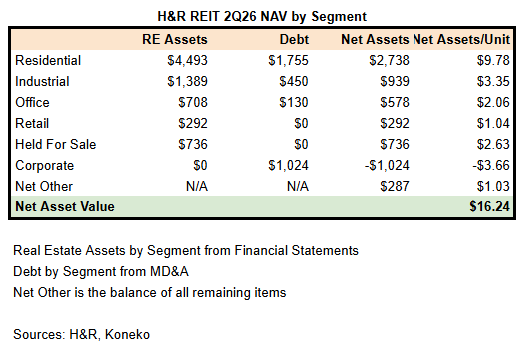
In the absence of any initiatives to deliver value to unitholders, H&R’s market value would reflect the weakness of publicly traded peers:
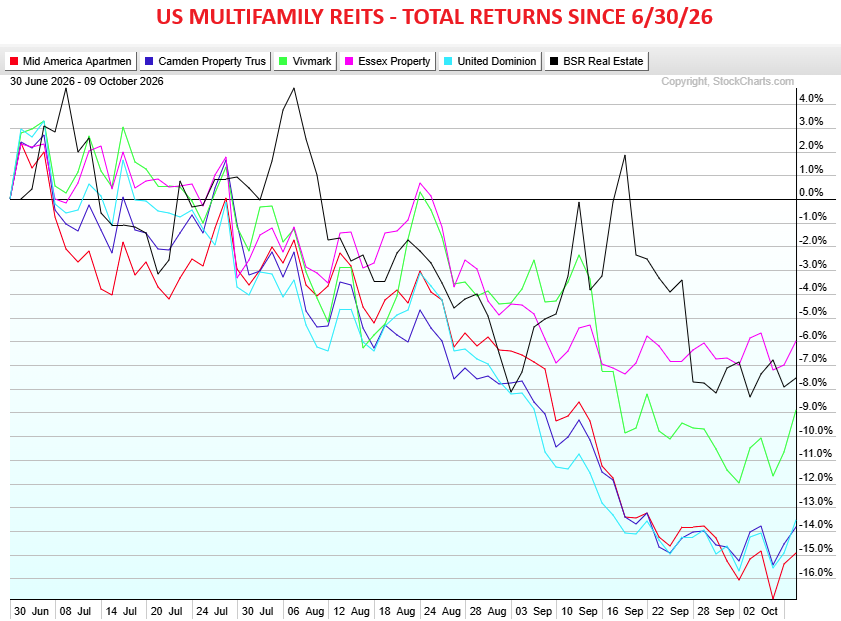
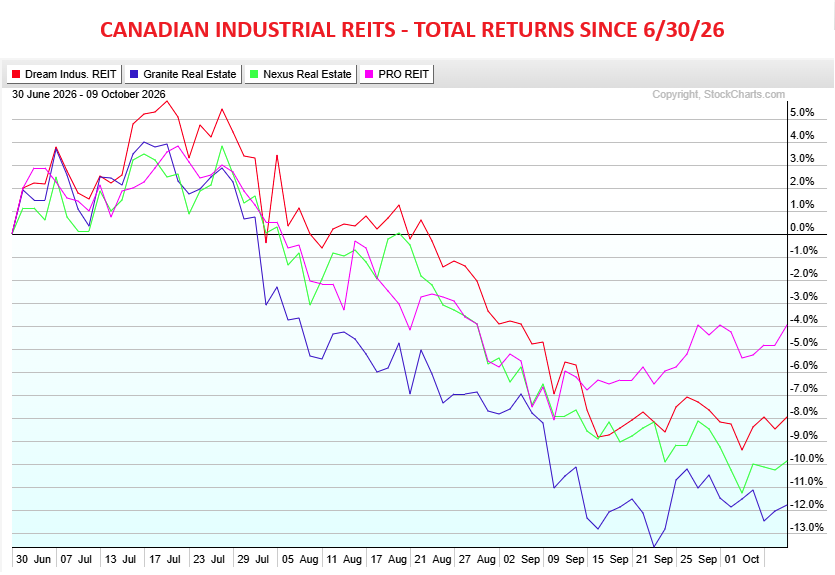
I believe US multifamily REIT valuations are very attractive with emerging evidence of the long-awaited Sunbelt upturn not yet reflected in REIT prices, however H&R’s properties are not uniquely superior. I believe Canadian Industrial REITs are very attractive with already strong operating performance poised to benefit from Building Canada initiatives, but H&R’s properties are not uniquely superior. I estimate that H&R would be trading close to C$9 if investors were not anticipating further corporate actions.
Lantower REIT Potential 4Q26 Value
Significant progress could be achieved by year-end 2026 without completion of the GO/CRAL arrangement:
H&R has agreements in place for asset sales:
Caledon Lands $436mm (vs $400mm IFRS value at 6/30)
26 Wellington East $75.5mm (closed)
25 Sheppard West $81.5mm (closed)
2200 John Muir Pkwy $26.2mm
200 Bouchard lease termination $56.1mm
The Industrial property sales included in the GO/CRAL arrangement were with third-parties at fair valuations and could proceed under new contracts. H&R disclosed a combined IFRS value of $1,547mm for properties that would be sold to Crestpoint ($728mm) and Blackstone ($680mm). I estimate the sales achieved a cap rate of 6.4%.
These sales would establish H&R as a US multifamily REIT with a Class A Sunbelt portfolio and a non-core segment that will be liquidated over time. High quality assets, simpler narrative, and simpler financial statements should shrink or eliminate the complexity discount. A substantial portion of the asset sale proceeds could be distributed to unitholders, as was also contemplated under the GO/CRAL arrangement.
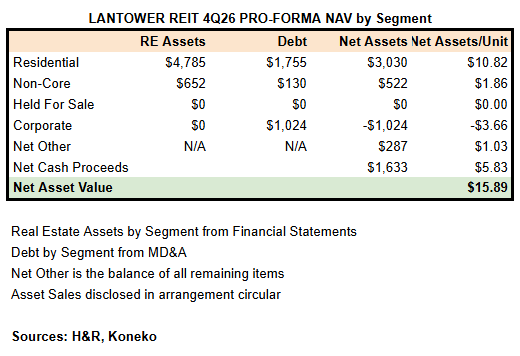
I consolidate H&R’s former “Retail” segment into Residential since it had only one remaining asset, the shops and offices at River Landing in Miami. That retail space is anchored by a Publix supermarket, a strong tenant as described in my Slate Grocery profile.
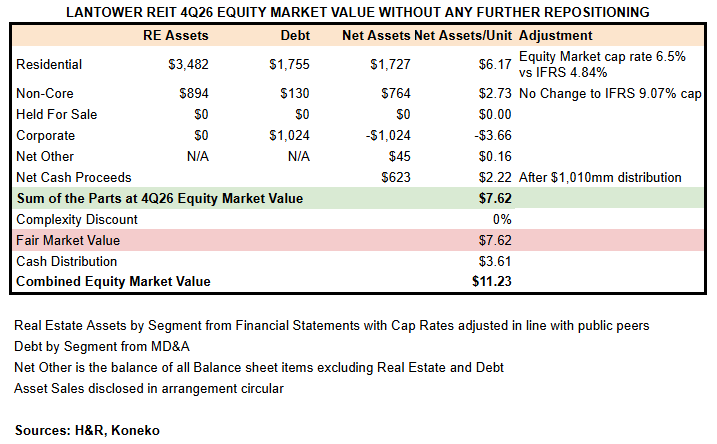
Some fellow unitholders will be disappointed that the Equity Market Value is not higher, but:
The low result is largely attributable to the collapse in multifamily peer valuations (6.5% cap rate).
The 10/9 closing price of C$9.57 provides an additional 15% discount to this discounted market value, or 22% after the $3.61 distribution.
Strategic Options
Several paths could narrow the discount between pro-forma Lantower market value and pro-forma Lantower NAV:
Cash Sale. The highest non-binding offer received in last year’s Strategic Review process was $12.50, but that was under stronger market conditions for multifamily REITs and lower interest rates. I believe a savvy acquiror could now submit an all-cash bid of $11.50 that would have to be considered superior to the GO offer. The price will be affected by whether the GO/CRAL deal termination fee of C$102mm ($0.36/unit) is payable.
Cash Sale + Liquidation. A couple of offers were received in 2025 that would have paid a fair price for the more easily valued assets and a contingent payment depending on future proceeds from non-core assets. Combined proceeds under a similar structure could be $13.86/unit. The savvy cash buyer at $11.50 would be expecting to realize this value in 2-3 years.
C$8.80/unit could realized from cash sale of the Residential assets at a 5.50% cap rate. At a more conservative 5.7% cap rate, proceeds would be $8.27/unit.
C$3.61/unit could be distributed in cash in 4Q26 from Industrial proceeds
C$1.45/unit could be realized over time from liquidation of the non-core assets and remaining working capital.
Wait. Sale of the Industrial segment should eliminate the complexity discount and Lantower would be positioned to participate in the developing multiyear rebound in the Sunbelt multifamily market. If investors had confidence in the future Lantower management and board then there would be no reason to sell under current weak equity market conditions. Full NAV of $15.89 could be achieved through equity appreciation plus distribution of proceeds from non-core asset sales.
Non-Core Assets
H&R’s longstanding strategy was to own a diversified portfolio of Class A assets in major markets. It may take 1-10 years to realize value from the remaining non-core assets, but none are fundamentally flawed. The larger pieces (currently reported under the Office, Residential, and Other segments)
$242mm of mortgages receivable. A majority of this balance will be eliminated through the acquisition of the Lantower REDT.
$341mm of US Offices (2 Gotham and 2218 Bryan). I’ve written about the binary risk at 2 Gotham from the 2031 lease termination. 2218 Bryan in Dallas is a trophy property serving as the HQ of Perkins & Will, the architectural firm that designed the renovation of the former school building - they won’t leave.
Est $115mm TC Energy Tower (50% owned) in Calgary. TC (and spinoff South Bow) occupy 100% of this 931ksf trophy property with a lease expiring in 2031. The local market has no alternative AAA space for them. Hypothetically, TC could move its HQ to Houston where there is another TC Energy Center, but I believe this is unlikely due to improved business prospects in Canada under the Carney administration. Hypothetically, TC could partner with a builder to construct a new Calgary HQ, but that also feels very unlikely - they would have to be close to breaking ground right now. It’s hard for HR to sell the building without knowing the rent TC will pay to stay, but once that is determined in 2-3 years the lease will secure a strong value for the building. It would make sense for TC to buy it since their cost of capital is lower than any office property owner right now.
Est $250mm 310-320-330 Front Street in Toronto which is largely vacant. H&R planned to replace 612ksf of existing offices with >1mm sf of residential density so there was no reason for RBC to stay. HR missed the opportunity to participate in the 2022 housing bubble and then pivoted to miss the opportunity to participate in the 2025 RTO rush, but with an investment in renovation and new amenities these buildings would be highly viable as offices.
? The Bow repurchase option at $737mm ($368/sf) in 2038 is far below replacement value for one of the best buildings in all of Canada in what was the worst office market in Canada. This option will eventually be worth a lot, but it’s hard to value in 2026.
Est $172mm for 459 Smith Street (Gowanus) - sale of this 737ksf development site can be completed once environmental remediation work is done. JLL removed its marketing listing early in 2026.
Est $190mm for The Cove (Jersey City), a 3mm mixed use development site on the waterfront in Jersey City. The 1.6mm residential component is highly viable, but the planned 1.4mm life sciences space will need to be reconsidered.
Est $160mm for 10 Lantower development sites.
Est $150mm for 7miscellaneous Canadian offices.
It will take time to realize full value from each of these assets, but none are dependent on any unique expertise of Tom Hostedter.
Termination
The GO/CRAL arrangement specifies a C$102mm termination fee payable by H&R if it fails to receive unitholder approval, accepts a superior offer, or changes its board recommendation. If H&R ends up paying any deal termination fee then I believe that CEO Tom Hofstedter should be terminated “for cause” and without any further compensation.
I believe he pushed H&R into a transaction that caused significant harm to public holders through undervaluation of the non-core assets that he sought to acquire for his personal benefit.
I believe he failed to properly disclose his family ownership interest in H&R, even when their stake exceeded 10% as joint actors, and his family significantly increased its stake while Tom had material non-public information about H&R’s strategic alternatives process and he was preparing to participate in a bid to acquire H&R (the GO/CRAL arrangement).
I believe GO blundered by entering into the H&R transaction due to the heavy dilution of their capital markets narrative and financial statement asset value. GO should welcome termination, but if they persist then it invites greater scrutiny of their motives. Why do they want to complete a deal which has already been so costly to their investors (GO unit price -21% since the deal was announced)? I suspect there are hidden flaws in their backgrounds and financial reports.
A Google image search for pictures of GO Residential CEO Joshua Gotlib appears to have been scrubbed of any accurate results. Is Josh trying to hide more than his bad haircut?

If Gotlib has been so successful at removing pictures from the internet, then what has he been able to hide about his past business dealings? If GO demands payment of a termination fee then HR should contest the accuracy of GO’s financial reporting, representations, and warranties.
Disclosures & Notes
At the time of publication the author held units of H&R REIT and no position in units of GO Residential. This disclosure should not be interpreted as a recommendation to make any transaction in any security. Investors are encouraged to check all of the key facts cited here from SEDAR filings and other sources prior to making any investment decisions. The author believes all information in the article is accurate as of the date of publication.
A copy of this article was sent to H&R REIT at the time of publication. If the company can identify any factual errors using information that was public at the time of release then corrections will be made as promptly as possible.
I believe this article serves the public interest so it has been published with no paywall. Please share with anybody who might be interested.