

H&R REIT (TSX:HR.UN) has lost C$151mm in market value (to 8/14) since announcing its merger with GO Residential REIT (TSX:GO.U). Investors were disappointed by the low value of the GO equity received and the accurate perception that the deal would unfairly benefit insiders. GO lost US$74mm due to the dilution of its narrative and extremely heavy dilution of NAV. The transaction is a lose-lose idea and should be abandoned.

Emily Watson (H&R President): “Our sunbelt portfolio fair market value is supported by a third-party appraisal and recent market transactions, thereby maintaining a weighted capitalization rate of approximately 4.97%. High-quality multifamily assets across the sunbelt continue to trade at cap rates, driven by the region’s compelling long-term fundamentals, including robust population, employment growth, business-friendly environments and durable migration patterns that underpin lasting value creation.” - H&R conference call 11/14/25
Josh Gotlib (GO Residential CEO): “We’re buying the portfolio [Lantower] at a 7% cap on year one NOI” - GO conference call 8/14/26
Topics:
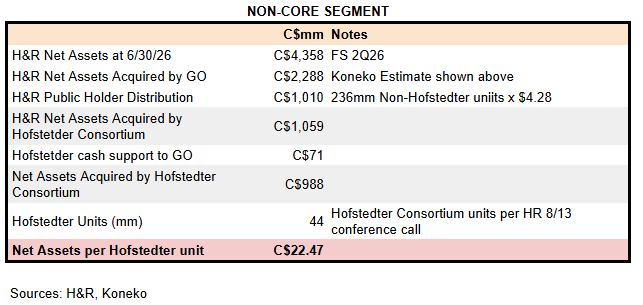
Transaction Structure. The deal sets up a huge potential gain for H&R CEO Tom Hofstedter and related parties. Based on the limited disclosure to this point, I estimate they will receive H&R assets valued at $22.47/unit.
GO Residential’s Fraud Concerns. GO CEO Josh Gotlib is accused of defrauding the widow of the partner who provided the capital for his Black Spruce investment group. GO’s largest independent unitholder Alfred Teo has a history of regulatory violations and spent 11 months in jail following a fraud conviction.
Go Residential’s Valuation Concerns. Issuance of approximately 134mm GO units to acquire Lantower will dilute GO’s reported NAV to approximately $15.45, a stunning 38% drop in just over a year since IPO. If GO’s valuations were correct then it should be selling assets rather than units.
GO Residential’s Poor Record As A Property Manager. Gotlib and Orbach have brought a penny-pinching affordable housing mindset to GO properties and tenants are unhappy.
Deal Prospects. The transactions require approval from a majority of votes cast, excluding those owned by the Hofstedter Consortium. No significant independent unitholders have committed to support the transaction. The market says it’s a bad deal and approval may be difficult.
Alternative Path? Sell Industrial as contracted, distribute proceeds, launch Lantower as successor to H&R with new CEO in place of Tom Hofstedter, and sell non-core assets over time.
Transaction Structure
H&R’s diversified assets are being split into 3 parts (see H&R Press Release and Presentation):
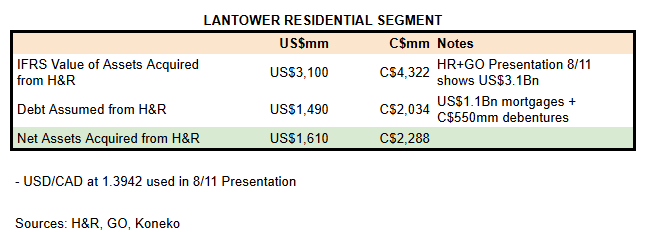
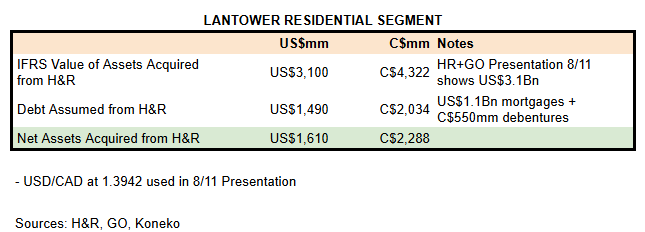
Lantower Residential Segment will be merged with GO Residential. Each H&R unit (except those owned by management and related parties - the Hofstedter Consortium) will be exchanged for 0.5688 GO units. GO will assume US$1.1Bn of mortgages and a C$550mm debenture obligation. HR/GO disclosed that the IFRS fair value of assets acquired will be US$3.1Bn which will include the public interest in the Lantower REDT. These implies that the H&R equity attributable to the segment will be about US$1,610mm or C$2,288mm.
Industrial Segment is being acquired by Crestpoint (existing 50/50 JV partner) and Blackstone (presumably buying all the non Crestpoint assets). The price was not disclosed. Proceeds will mostly be returned to investors excluding the Hofstedter Consortium through a $4.28/unit distribution. The valuation of these arms length transactions for stabilized assets should be close to IFRS carrying value, but details have not been disclosed. We don’t know whether these sales will include H&R’s Caledon lands worth about $300mm, including 97 acres worth about $194mm likely sold within a year for development of Highway 413.
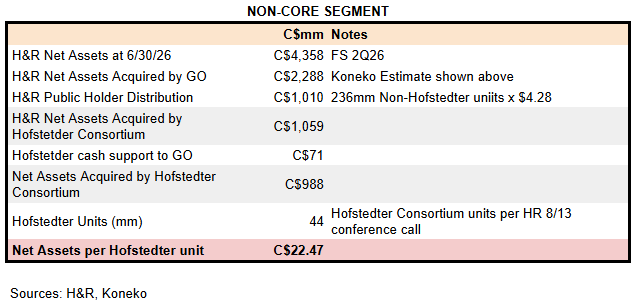
Non-Core Segment will be acquired by H&R CEO Tom Hofstedter and related parties in exchange for 44 units (including exchangeable units). H&R’s Lead Independent Trustee Stephen Gross said “We are not breaking down the individual proceeds by asset class at this stage”.
We know the equity distributed via the $4.28 distribution, and have estimated the equity exchanged for GO, leaving a balance of $1,059mm HR equity in the Non-Core Segment. Hofstedter has promised C$71mm of support to GO, leaving a net value of $988mm, equal to C$22.47 per Hostedter Consortium unit, and potentially a vastly more attractive outcome than the one imposed on H&R’s public unitholders. It’s no wonder that all of his family and friends are joining his deal. The Non-Core assets have been repeatedly marked down in H&R financial statements over the past 5 years and have further appreciation beyond that value. On 8/13 Hofstedter said: “I am excited about the outcome.”
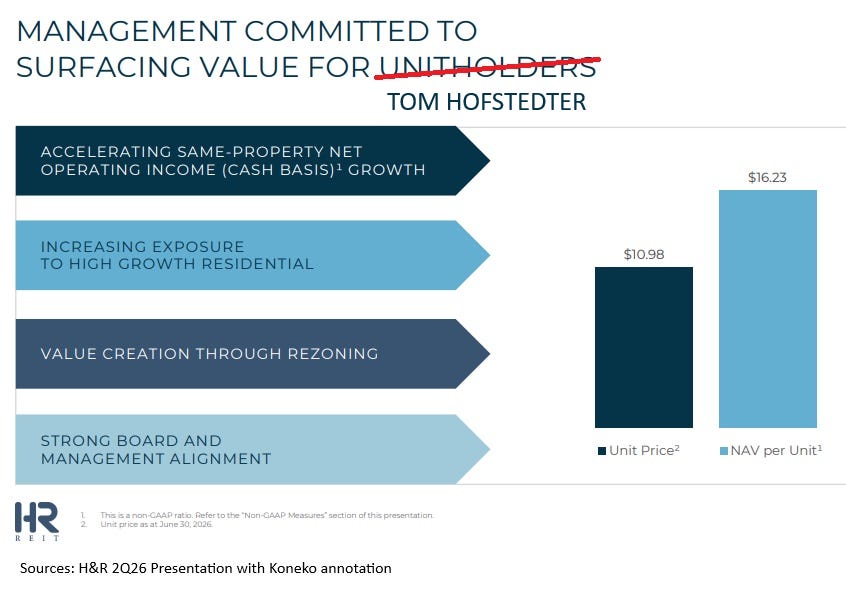
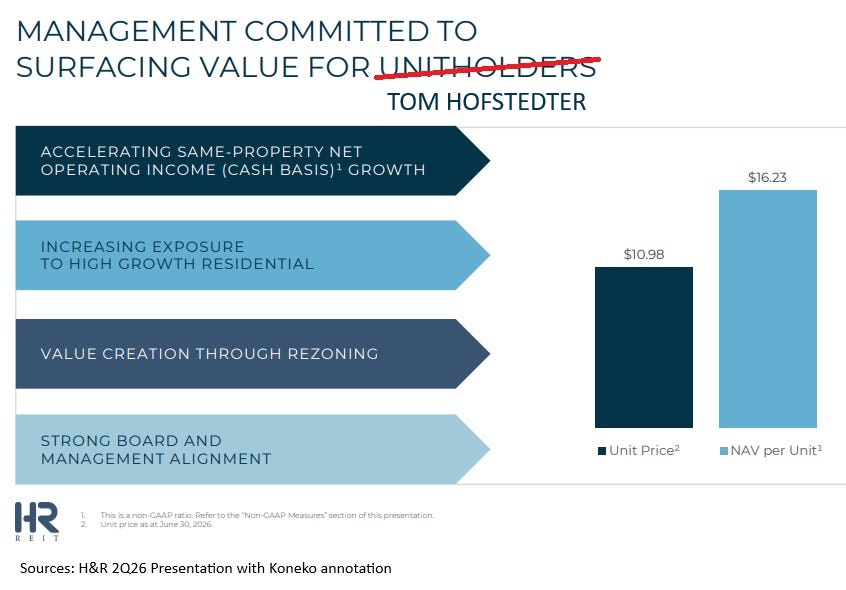
As an H&R unitholder, I would love to be proven wrong about the amount of value being transferred to the Hofstedter Consortium. Maybe some positive net working capital is being transferred with Lantower? Anything else? Very little information was provided about plans for consolidation of the Lantower REDT and its existing debt - that might shift my numbers by $100mm, but not alter my conclusion.
GO Residential Fraud Concerns
A 2023 article in the Real Deal about GO CEO Josh Gotlib said: “The source of his capital remains a mystery that even many of New York’s biggest brokers haven’t solved. One person with knowledge of the company said Gotlib taps a small network of private investors.”
Two possible sources:
1) Natalia Legg vs Gotlib
The complaint (link to full text) alleges gross misconduct, fraud, and self-dealing by Joshua Gotlib against the widow and child of his deceased business partner, Oliver Legg. The lawsuit explains that Oliver Legg co-founded the Black Spruce group of real estate entities with Gotlib, making Gotlib an equal (50%) partner, although Oliver provided the capital. Oliver placed his 50% interests into a trust for the benefit of his wife, Natalia, and their daughter, Daria, and appointed Gotlib as trustee in 2014. Gotlib was also the managing member of the trust’s portfolio companies, including Black Spruce Properties and Black Spruce Management.
The complaint details Gotlib’s alleged scheme, which includes:
Fraudulent Transfer: Days after Oliver’s death in May 2015, Gotlib allegedly misled Natalia into ratifying the transfer of the trust’s 50% interests in BSM and Nieuw Amsterdam Property Management to himself. Gotlib misrepresented that these entities were losing money and that he would personally take responsibility for outstanding loans.
Breach of Agreement: Gotlib failed to perform his promises, allegedly diverting BSM’s revenues to himself and using the trust’s assets through BSP.
Self-Dealing: Gotlib allegedly engaged in ongoing self-dealing, including borrowing large, high-risk, unsecured sums from the trust to finance his other businesses, causing the trust to suffer losses.
Diverting Opportunities: Gotlib allegedly diverted new real estate investment opportunities from BSP to separate shell companies under his ownership, allowing him to reap 100% of the growth of Black Spruce.
Gotlib denies the claims and the case is currently in arbitration.
2) Alfred Teo
Alfred Teo is the largest independent unitholder of GO Residential with a disclosed 18% stake and his son Mark Teo is on the Board of Trustees. Alfred Teo has a history of legal and regulatory troubles:
He pled guilt in an insider trading case in 2007 and served 11 months of a 30 month prison sentence.
In 2011 he was fined $49.5mm in a case brought by the SEC.
He was indicted for a $61mm tax evasion scheme related to activity from 2016-2018.
Teo was a “Retained Interest” holder at the time of GO’s IPO, indicating a prior business relationship with with GO Partners. Has convicted fraudster Alfred Teo been backing alleged fraudster Josh Gotlib for many years?
Troubling Association of Stephen Gross (H&R’s Lead Independent Trustee)
Since 2008 Stephen Gross has served as a Director of New Jersey based Cross River Bank. During that time the bank has been subject to multiple regulatory investigations and enforcement actions:
2018 FDIC Settlement for Unfair and Deceptive Practices (LINK)
House Subcommittee (LINK and LINK) and SBA (LINK) investigations into PPP Loan Fraud
2023 FDIC Consent Order for Fair Lending and Oversight Failures (LINK)
Stephen Gross is a longtime Cross River Bank board member and a member of its lending/credit committee, but was not individually cited or sanctioned in any of these investigations. The HR/GO agreement includes appointment of 2 HR trustees to the GO board. Stephen Gross sounds like he might fit in well.
GO Residential Valuation Concerns
GO’s apparent discounted valuation depends on a belief that its portfolio was worth 34% more at IPO than the prices where the buildings were acquired from third parties in 2022.
The Copper Buildings were acquired by Black Spruce Management for $837mm in March 2022 (link).
685 First Avenue was acquired by GO Partners in October 2022 for $387.5mm (link)
One Sutton Place, Two Sutton Place and One East River Place were acquired by GO Partners in December 2022 for $825mm (link)
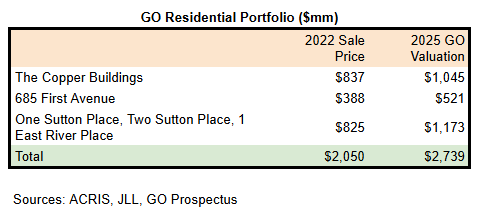
The benefit to property valuations of rising rents since 2022 has been largely offset by a rise in cap rates of about 166bp (Avison Young Second Quarter 2026 vs Avison Young Second Quarter 2022) due to higher mortgage cost. Avison Young estimated an average 2Q26 Manhattan multifamily cap rate of 5.98% with a range of 4.50-7.50%. GO’s 2Q26 financial statements valued its properties at a 4.16% cap rate:

For comparison, H&R REIT has reduced the valuation of its Jackson Park luxury rental complex in New York by 7.5% since 3Q22 (from $1,987mm to $1,837mm). Another strong comp is 265 East 65th Street which was acquired by GO Partners for $425mm as part of a package with 1&2 Sutton Place and One East River Place. The latter properties were contributed to GO Residential at valuations 42% higher than what GO Partners paid. A 45% stake in 265 East 66th sold this year to a sophisticated buyer (RXR) at a $435mm valuation (only 2% appreciation). If GO’s properties were valued at their 2022 prices then unitholder equity would be US$689mm lower and NAVPU after the IPO would have been $12.37 instead of $24.80.
The financial statement impact of the Lantower acquisition would be heavily dilutive:
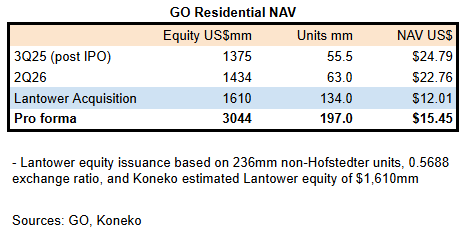
GO’s willingness to issue equity far below reported NAV in March 2026 (bought deal at US$9.95/unit) and through the Lantower acquisition raises several possible concerns:
NAV might be significantly overstated. The H&R merger justifies sale of Lantower at a discount on the basis that GO is more heavily discounted. If the fair value of the GO portfolio is much lower than reported then the relative values would be reversed, H&R unitholders would suffer dilution from the merger, and the purported valuation upside would be illusory.
GO’s portfolio might have undisclosed legal or financial problems in its history. Piling on new clean assets would bury past problems. It gets lost in the deal dazzle.
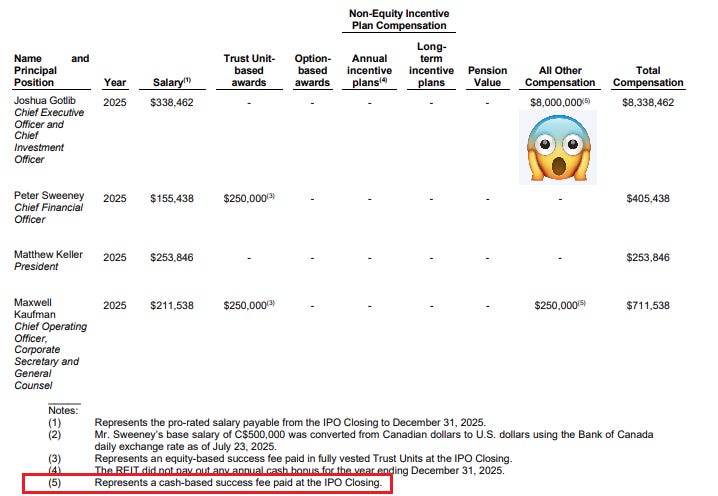
GO management might expect benefits from the REIT independent of the return on their equity interest. For example, GO CEO Josh Gotlib received an $8mm cash bonus from the IPO proceeds.
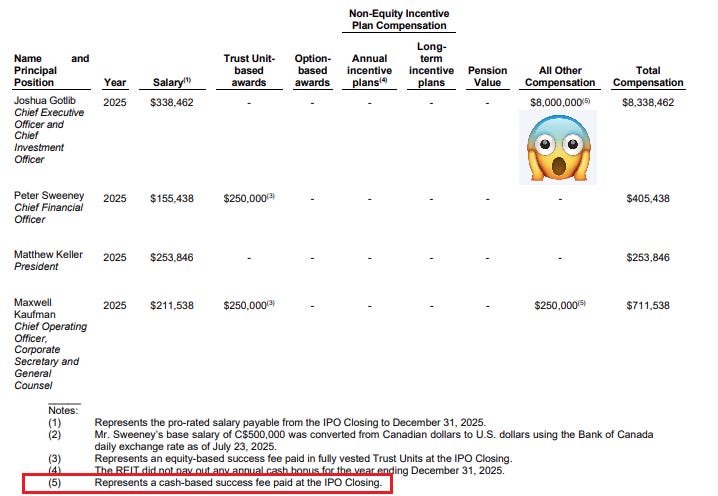
GO has argued that its equity is significantly undervalued and it owns premium quality luxury assets in a supply constrained market. Josh Gotlib says he has heard from unitholders that demand for GO was limited by its scale, liquidity, and balance sheet. In contrast, what I have heard from investors who opted not to invest in GO has been that their primary concerns are governance issues.
This week GO announced that its 2Q26 results exceeded every guidance metric and that the Lantower acquisition would result in increased scale, liquidity, institutional appeal, and improved balance sheet. GO’s unit price continued falling. Maybe those were not the problems. The REIT did nothing to address governance concerns and undermined the prior narrative by diluting NAV and expanding to less appealing assets in weaker markets. It might take 10 years for GO to recover the NAVPU lost through dilutive equity issuance since IPO.
On 8/13 Hofstedter described the GO management team: “These are smart, disciplined buyers and managers with a singular residential mandate and a real track record.” What is that real track record? Prior to entering the luxury segment, The Orbach Group acquired, and continues to own, US$5Bn of affordable housing properties in New York City. Gotlib’s Black Spruce entities acquired US$4.5Bn of affordable housing. That sector has been the worst possible real estate to own in New York City. Did Hofstedter and the H&R Board study the real track record of the Gotlib and Orbach entities through this period:
2019 Housing Stability and Tenant Protection Act repealed vacancy decontrol, capped rent increases allowed for Individual Apartment Improvements and Major Capital Improvements.
2020-2022 Pandemic eviction moratoria and housing court backlogs led to severe rent arrears while also contributing to expense inflation.
2022-2024 Higher interest rates and loss of liquidity from failing banks (Signature and New York Community).
2024-2026 Distressed Turnover with forced sales and property values 40-50% lower than 2019 peak. Landlord equity at many buildings has been wiped out.
In my opinion, GO’s reputation would be positively transformed if it were able to sell any of its initial portfolio assets at carrying value.
GO’s Poor Reputation As Property Manager
The average Yelp Review ratings for GO’s One Sutton Place (2.1), The Copper Building (2.5), 685 First Avenue (2.0), and One East River Place (1.8) are below the Rikers Island Correctional Facility (3.2)
Many Google reviews are critical of property management, often citing a deterioration in service following a change in ownership (when GO took over). These summaries were prepared by Google Gemini in response the prompt: “summarize google review comments about management at [Building Name]”
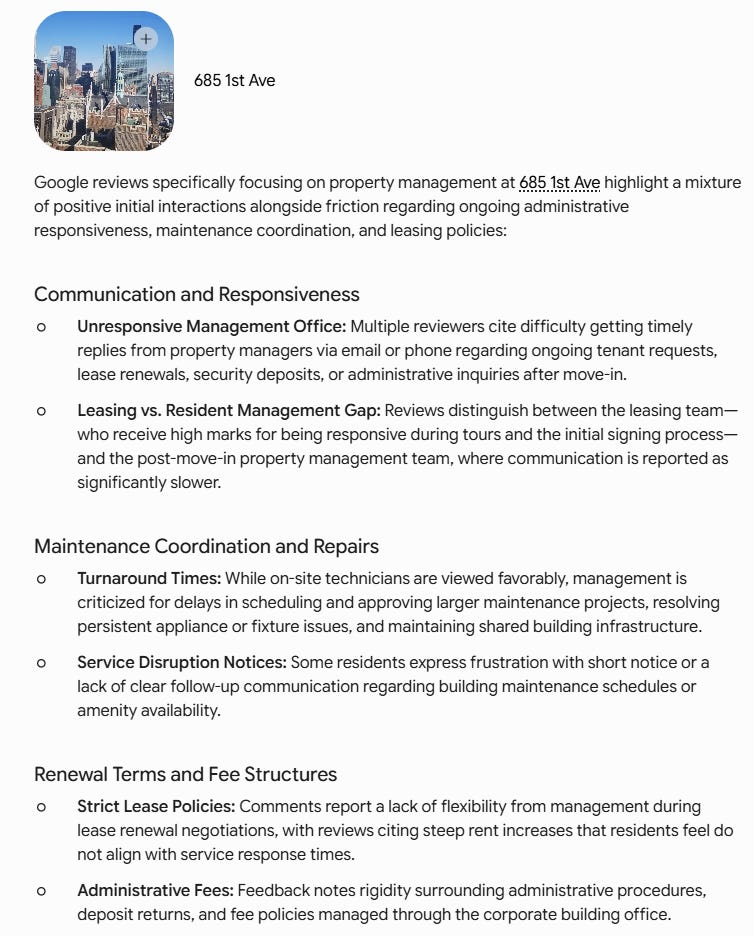
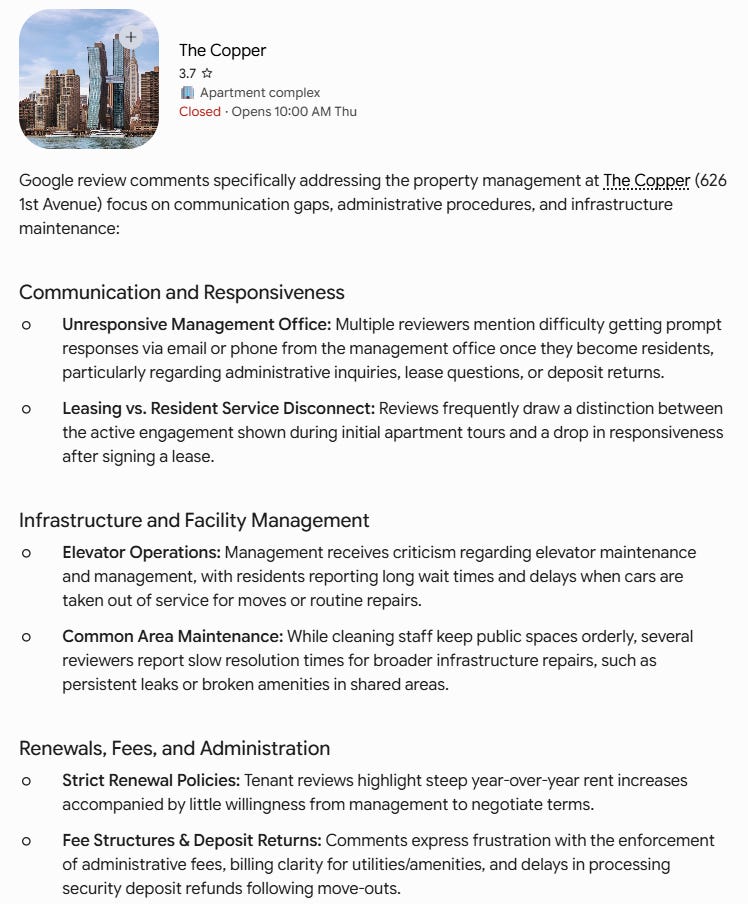
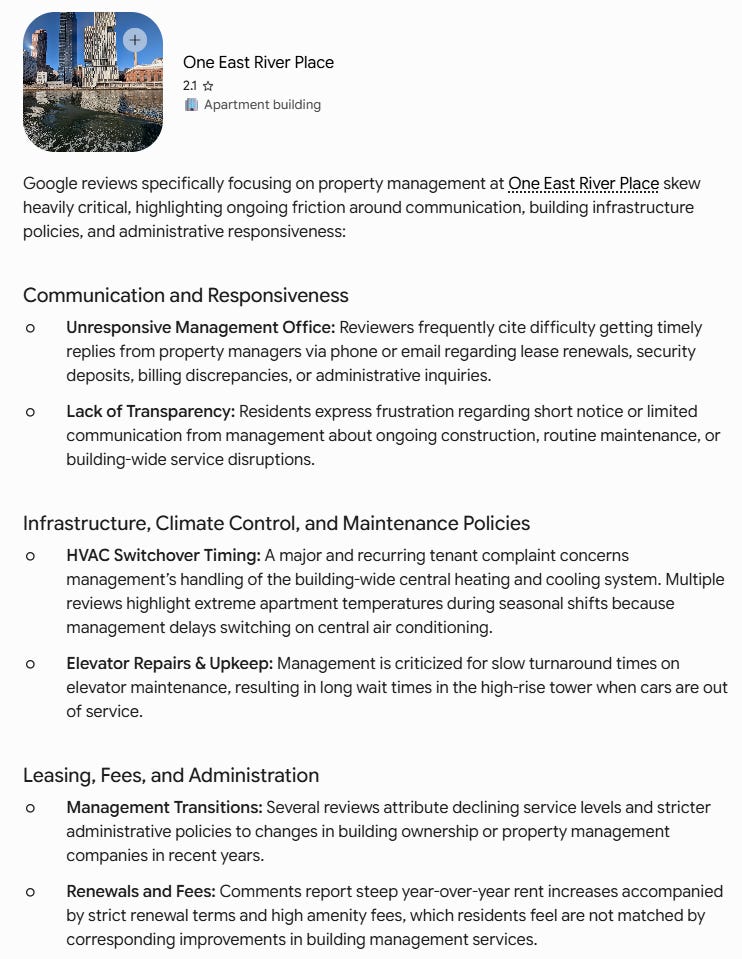
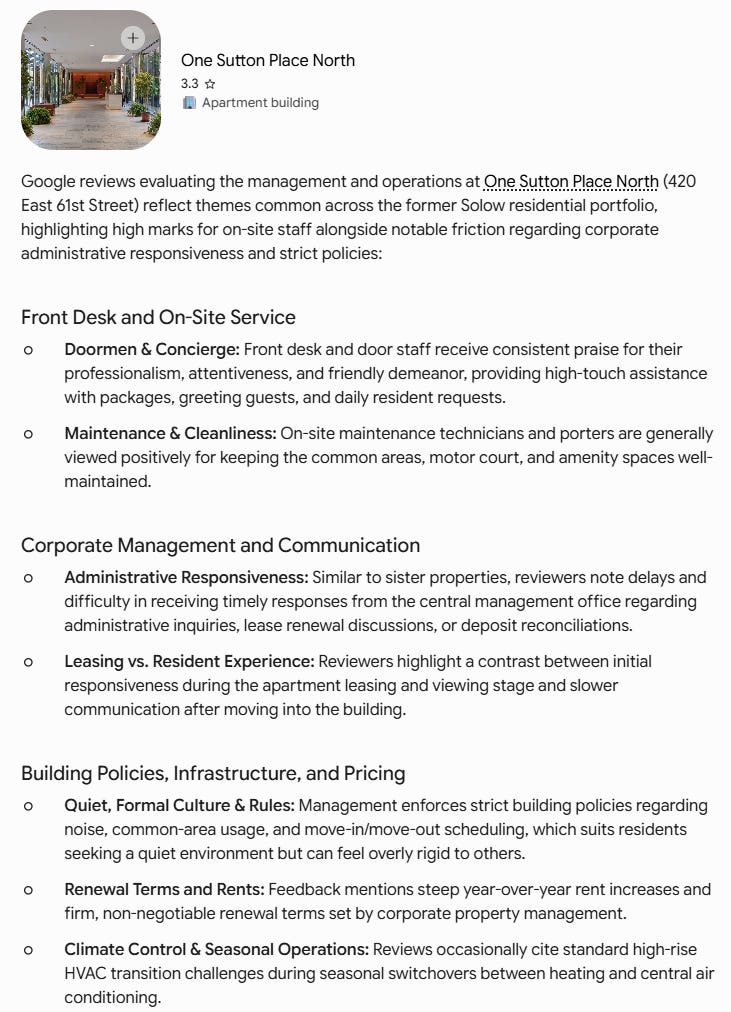
The average rating at these properties still benefits from reviews submitted prior to GO control. Gotlib has a longer “real track record” as property manager of his affordable housing portfolio. New York City Housing Preservation and Development records show him as involved in ownership/management of 224 buildings which have accumulated 42,663 violations, of which 4,232 remained open at 8/14/26. That’s a lot of 🪳🪳🪳.
Lantower has a proven record of success in apartment development and management. GO Residential does not. Gotlib’s track record suggests that the “margin enhancement initiatives” GO intends to apply to the Lantower portfolio will be penny-pinching service cutbacks, maintenance deferrals, and billing surprises. A GO tenant told me that his building has a transient population of new arrivals and divorced dads. Somebody will take every apartment in Manhattan due to limited current supply, but in many Lantower markets renters have abundant choices.
On August 5, 2026, tenants at The Copper Building filed suit alleging that management overcharged approximately 1000 rent stabilized tenants in the building. Plaintiffs attorneys estimate cumulative overcharges since 2020 were about $20mm.
Deal Prospects
H&R and GO held 3 conference calls and distributed 3 presentations last week. If there were good reasons to support this deal then we would have heard them. Tom Hofstedter promised the circular to be released in few weeks would answer investor questions. Mine are:
What other options were considered for Lantower and why were those rejected? What other cash and equity exchange offers were received?
Why did the Board accept a transaction valuing Lantower far below the level previously claimed by H&R management?
Was any investigation made of the background of GO management, their track records, and extensive business activities outside of GO? Did the Board and advisors review the financial condition of the Gotlib and Orbach affordable housing entities? Did the board consider the risk that value could be diverted from GO to support those assets?
Was any assessment made of legal and regulatory risks of GO management, GO properties, and any connected parties? Were all outstanding legal matters, including the American Copper lawsuit, fully disclosed to H&R?
Are there any meaningful differences between the asset values assumed in merger negotiations from the IFRS values reported as of 6/30/26?
H&R equity ownership is highly diluted.
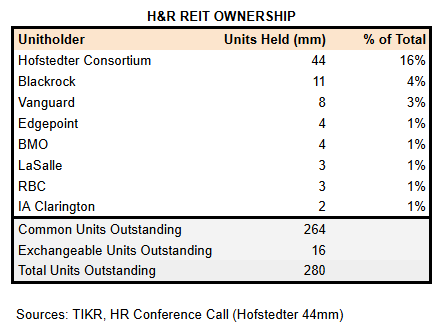
Approval of of the deal must pass 3 voting tests:
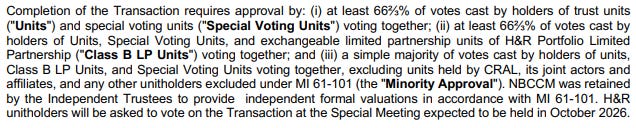
If the Hofstedter Consortium holds 44mm units (16% of outstanding) then the first 2 are probably achievable. However the third test could be difficult since the vote will be limited to the Non-Hofstedter unitholders who are obviously getting the worst part of the deal. The deal consideration is currently valued at C$11.08 (0.5688 GO at $8.57 plus C$4.28). It’s not credible for HR to promote GO upside when it has destroyed so much unitholder value since IPO through dilutive equity issuances.
Alternative Path
In my opinion these steps would deliver an improved outcome for H&R unitholders:
Close the Blackstone and Crestpoint Industrial sales. These are arms-length transactions at fair market prices. Proceeds should be distributed to H&R unitholders.
Launch Lantower Residential as successor to H&R:
Emily Watson as CEO. Pass the mic, Tom...
Non-Core Assets to be segregated as a legacy segment in financial reporting.
Tom Hofstedter to retire as CEO, but remain as an employee or consultant to supervise the orderly liquidation of the non-core assets with all proceeds to be distributed to unitholders. Hofstedter’s compensation should be directly linked to the proceeds.
Appointment of a new independent non-executive Chairman. The GO deal shows that Hofstedter can no longer be trusted to protect the interests of public unitholders.
Replacement of most of the existing Board with new independent nominees appropriate to the US residential business. Unless the circular reveals super-positive aspects of the GO deal that were somehow not mentioned in the conference calls then Stephen Gross and the other Trustees who approved the deal need to go.
If Josh Gotlib is correct that the existing deal values Lantower at a 7% cap rate then I believe my plan would provide an immediate win for H&R investors. I’ll provide a detailed valuation commentary using the financial information from the Circular once it is released. My guess is that it will end up with a near-term value of $12 to 12.50 with upside over time as proceeds are returned from Non-Core asset sales and Sunbelt rental markets recover. This is not a recommendation to buy or a price target because H&R management is working towards a different outcome that the market correctly views more negatively.
Disclosures & Notes
At the time of publication the author held units of H&R REIT and no position in units of GO Residential. This disclosure should not be interpreted as a recommendation to make any transaction in any security. Investors are encouraged to check all of the key facts cited here from SEDAR filings and other sources prior to making any investment decisions. The author believes all information in the article is accurate as of the date of publication.
A copy of this article was sent to H&R REIT at the time of publication. If the company can identify any factual errors using information that was public at the time of release then corrections will be made as promptly as possible.
I believe this article serves the public interest so it has been published with no paywall. Please share with anybody who might be interested.
I Don’t Wanna GO
In my opinion, GO's entire modus operandi was to de-risk their core Manhattan properties which they bought with their own private capital. I avoided it until it was around $10, got in and got out (oddly to buy H&R!). I was surprised to see Cohen and Steers take so much down as they specialize in the space and are from New York City (like GO's original properties...) Then you have Vision Capital from Canada who also has a huge position. Andrew Moffs & Jeffrey Olin have been loving it all year and made it routinely a top holding/pick.
Fidelity Funds are also bright people, from the US, and bought in. So you do have bright people who bought into the GO IPO at $15 thinking it was cheap.
The stock is now at 6.9% implied cap if incorporating the Lantower portfolio or 6.5% otherwise according to RBC this morning. Tough to argue it is not cheap, today or with Lantower. I have found private market comparables in the past months in Manhattan / New York which seem to demonstrate GO is cheap. Today's price is less then what the Blackspruce paid in 2022 when vacancy rate in Manhattan was significantly higher.
Like you said, I think the smart thing to do is prove out the NAV by selling one of their original buildings. Perhaps they will do this when the deal closes. They aluded to 'capital recycling' on the Q4 conference call based on recent private market comps.
In the end, i suspect they plan to become a US REIT and sell it all within the next few years at a much better price. In the meantime, they have successfully used Canadian markets to de-risk their original 5 port highly correlated portfolio in Manhattan.
Question I have is what can go wrong to lose money here at current valuation??? You didn't mention it but insiders including Teo have upped over $50 million since IPO at higher prices. Not something you usually see in names without value.
Overall I may have voted for a deal like this if it was more transparent and fair, preferably by returning the other part of the portfolio in cash rather then doing a shady deal with the Hofstedter family. I think the premis for the merger is very realistic, to see a multiple re-rate, given the size, scale, high distribution, low multiple of the potential "GO" entity proforma.
Also if HOfstedter would have taken the GO units it would have corroborated his views on the opportunity, but he is cashing out. I agree with him, several of those properties are tough to sell, likely illiquid, but it seems as you point out he was marking them down perhaps with dirty ambitions. We know Front St in Toronto is a good office & Gowanus he told us had a buyer on the last call. Halifax is a good market and all leases are to the government.
Thank you very much Koneko for everything you have done to bring attention to GO Residential. Very unfortunate that unitholders couldn't have been given an all-cash offer or that H&R couldn't have continued disposing assets as they had been previously doing while unitholders received their monthly distributions. I'm not sure why anyone unhappy with the performance of H&R Reit would want their H&R units converted to GO which really seems like 'more of the same' if not worse Management (!). I'm admittedly a tourist in this area so maybe I'm wrong however it seems highly unusual to me that a company (GO Residential) would so heavily dilute their existing unitholders when trading so far below their stated NAV. Doesn't inspire confidence for future unitholders in my opinion. Wish everyone well with their decision and I'm sorry we didn't get the clean exit most of us thought would eventually come.