

Canadian Real Estate has delivered an attractive +11.3% ytd total return (XRE a/o 8/7). US REITs are +12.4%, and the CAD is -1.6% vs USD. Economically sensitive Retail and Industrial equities have been strong in Canada. Lodging and Data Centres have led in the US.

Equity markets are near all-time highs despite unresolved macro risks:
Iran War and Strait of Hormuz closure. None of the US war aims have been achieved and none appear achievable with the strategy employed to this point. The economic crisis that many predicted in March has not developed, however supply interruptions raised prices for energy and any goods and services with high energy inputs. The World Bank’s latest forecast is for global real GDP growth to fall to 2.5% this year (vs 2.9% in 2025) while inflation rises to 4.0% (vs 3.3% in 2025). Stagflation has resulted in higher interest rates that should reduce the value of financial assets.
AI Bubble. Capital is not scarce in anything connected to AI! I cannot believe that $1Tn/year of capex can be profitably invested, but the competition to spend the not scarce capital is driving demand for hardware, construction materials, electrical generation, and premium NY/SF office space. Equity bubbles over the past 10 years in blockchain, additive manufacturing, crypto, COVID healthcare etc... had much less impact on the real economy.
Debt Bubble. 15 years ago S&P downgraded the US sovereign credit rating with total public debt outstanding of $15Tn. Now the debt is $40Tn, growing $2Tn/year, and nobody cares.
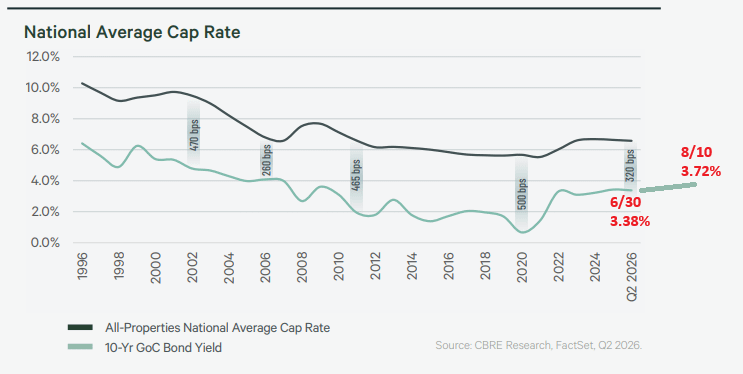
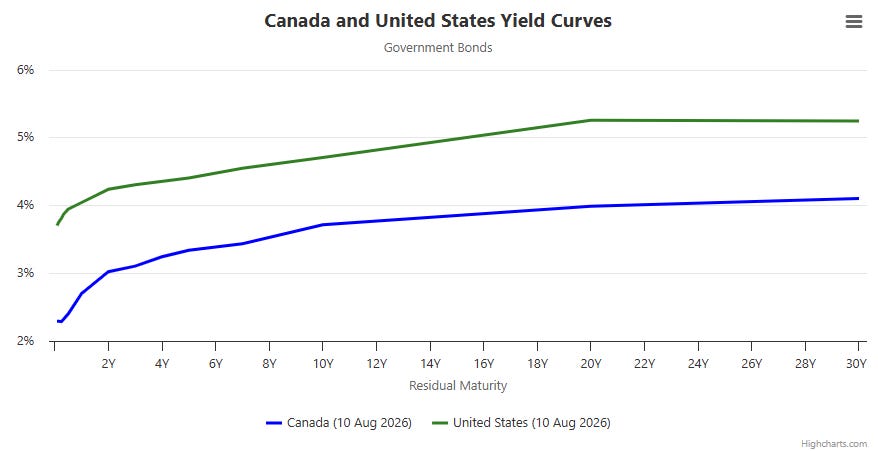
These factors have pushed the yield-to-maturity of the S&P Global Developed Aggregate Ex-Collateralized Bond Index from 3.65% at 12/31/25 to 4.15% on 8/7/26. US treasury 10-year yields have risen from 4.20% to 4.71%. Canadian 10-year yields have risen from 3.47% to 3.72%. Real estate assets with pricing power can pass along inflationary pressures to tenants through higher rents. On the other hand, most residential real estate is struggling - operating costs and interest expense are higher, but it’s been hard to raise rents.
Catalyst dependent investment ideas are more vulnerable to higher interest rates or bursting bubbles because the catalyst might end up with lower than expected benefits, or none at all. Well-managed real estate platforms without excessive debt may benefit from cyclical downturns by making accretive investments in properties, acquisitions, or their own equity at bargain valuations.
Sector Overview:
The yield premium of real estate cap rates over 10-year bond yields is under pressure due to the sharp qtd rise in bond yields.
Canadian yields are still at least 100bp lower than the US at every maturity. For real estate investors, Canadian property offers a positive return over financing cost, but US property buyers may get little or even negative return on leverage.
Insiders at 20 of 34 REIT/REOCs were buyers since 1/1/26 and 7 had net insider sales. REIT/REOCs have repurchased $460mm of equity since 1/1 (reported to 8/7) with the largest buybacks at Boardwalk (5.4% of market cap), Clarke (3.5%), Dream Industrial (2.4% of market cap), Killam (2.1%), and CAPREIT (1.1%).
Topics:
Valuation Comparison ($)
Quick Takes ($)
Comments on Trade Ideas ($)